IBA DU Vocabulary: How to Actually Prepare
The IBA BBA/MBA English section has 25/30 MCQs in a 90-minute paper with negative marking. Here is how many words you need, which list to use, and an 8-week plan.

The short answer
The IBA BBA admission test gives you 30 English MCQs inside a 90-minute paper you also have to split with maths and analytical ability. Vocabulary shows up as synonyms, antonyms, sentence completion, and word-usage questions. Around 800 to 1,000 well-learned words covers almost everything the paper throws at you.
The word that trips people up in that paragraph is well-learned. Most candidates who fail the English section have seen more words than that. They just cannot retrieve them at 11:20 in the morning with a clock running and a wrong answer costing them marks.
What does the IBA English section actually test?
The paper is built as an aptitude test, not a syllabus test, so there is no official vocabulary list to finish. Based on past papers and published breakdowns from prep centres like PIE Academy, the MCQ section runs roughly 30 English questions, 30 maths, and 15 to 20 analytical ability, with 90 minutes for all of it. A 30-minute writing section follows, then a viva for shortlisted candidates.
Two details matter more than the counts.
Every section has its own pass mark. You cannot carry a strong maths score into a weak English score. The Daily Star's guide to getting into IBA makes the same point, and adds that the bar moves each year depending on how hard the paper was.
Wrong answers cost you. The Daily Star puts the deduction at 0.2 marks per wrong MCQ; some prep sources report 0.25. Either way, guessing blindly on a vocabulary question is a losing bet. Check the instructions printed on your own admit card and question booklet, because the figure has moved between sessions.
That negative marking is the reason half-knowing a word is worse than useless. If you recognise tenuous but cannot separate it from tenacious, you will pick one, get it wrong, and pay for it.
The four question shapes vocabulary hides in
| Question type | What it asks | What it needs from you |
|---|---|---|
| Synonyms | Closest meaning to a given word | Precise meaning, not a rough sense |
| Antonyms | Opposite of a given word | Meaning plus the word's positive or negative change |
| Sentence Completion | Fill the blank so the sentence holds together | Meaning plus grammar and register |
| Word usage/error spotting | Which sentence uses the word incorrectly | Multiple sense of the same word |
Only the first two are answerable from a flashcard. The last two need you to have seen the word doing a job inside a sentence, which is why memorising a two-word Bangla gloss and moving on leaves you stranded.
How many words do you need for the IBA admission test?
Between 800 and 1,000 words is the sensible target for most candidates, and there are diminishing returns after that. Word Smart 1, the book almost every IBA aspirant in Dhaka starts with, holds roughly 850 words. Finishing one list properly beats half-finishing three.
You will hear a friend claim they learned 3,000. Ask them to define ubiquitous and use it in a sentence about traffic. The number people quote is the number they read, not the number they can retrieve under a timer.
An IBA alum writing at Road to IBA says he sat the BBA test with around 200 new words while classmates carried lists of 1,500, and still cleared it, because he knew his 200 cold. That is the trade you are making every time you add another list instead of reviewing the one you have.
Why does the standard method fail?
Here is the routine almost everyone runs. Buy Word Smart. Read 30 words on Saturday. Read 30 more on Sunday. By Wednesday, Saturday's words are gone. You notice around week three, panic, go back to page one, and start the loop again.
Nothing is wrong with your memory. Hermann Ebbinghaus mapped this in 1885: newly learned material drops off fast in the first 24 hours and keeps sliding for days. Reading a word once, then not touching it for two weeks, is a plan to forget it.
The fix is not more hours. It is putting the hours in different places. A meta-analysis by Cepeda and colleagues in Psychological Bulletin, pulling together 839 measurements across 317 experiments, found that spreading study sessions apart beats packing them together, and that the ideal gap gets longer as the date you need to remember by gets further away. Same total minutes, better retention.
Practically, that means a word you meet today should come back on day 2, then day 7, then day 21, then a month later. Each return trip resets your memory and slows the next decay.
We built the SM-2 review engine inside WoahCab to schedule exactly that, but the principle works with paper index cards too. What matters is that reviews are timed, not vibes-based.
An 8-week vocabulary plan for the IBA test
Assume you have two months and roughly 45 minutes a day for English. Adjust the daily count if your window is shorter.
Weeks 1 to 2: build the base. Learn 25 new words a day, five days a week. That is 250 words. Do not chase difficulty; the IBA paper leans on mid-frequency words that appear in editorials, not on the exotic tail of a GRE list. Spend 15 minutes of your session reviewing, not adding.
Weeks 3 to 5: add and review together. Keep 25 new words a day, but now half your session goes to reviewing the backlog. You will hit around 600 to 650 words by the end of week 5. This is the stretch where most people quit, because the new-word count slows while the review pile grows. It is also the stretch that decides your score.
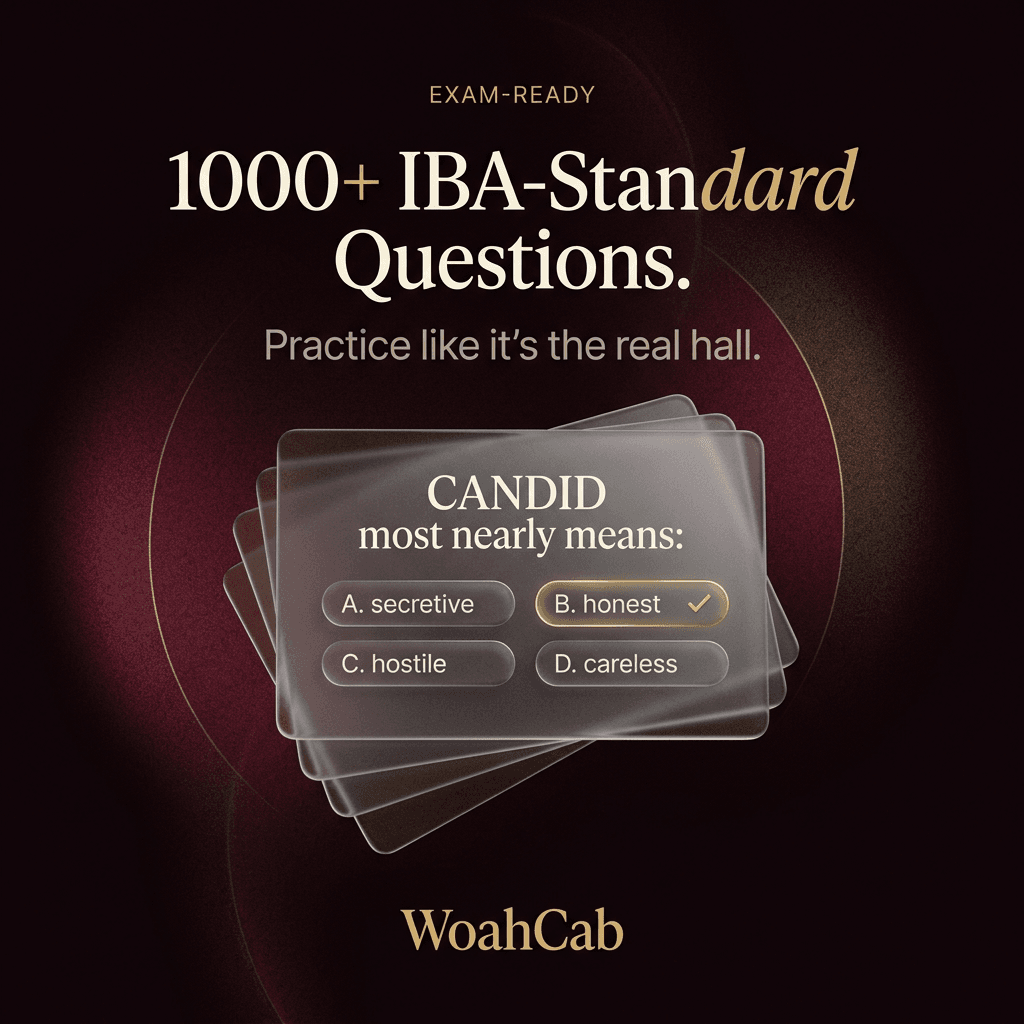
Week 6: switch to questions. Stop adding new words. Solve sentence completion and synonym-antonym sets under a clock, six to eight minutes for ten questions. Every word you miss goes back into review with the sentence you missed it in. WoahCab has over 1,000 IBA-standard questions built for this stage; past papers and Word Smart's own drills work too.
Weeks 7 to 8: full-paper timing. Sit complete MCQ sections with negative marking applied. Your target is finishing 30 English questions in 20 to 22 minutes so you can hand the spare time to maths. Track two numbers after each mock: how many you got wrong, and how many you left blank. If wrong answers outnumber blanks by a lot, you are guessing too freely for a paper that penalises guesses.
Before any of this, find out where you stand. WoahCab's free diagnostic test takes about ten minutes and tells you which of the 40 chunks to start from, so you are not spending week 1 on words you already own.
Four habits that separate high scorers
Learn the word inside a sentence. Anomalous and eccentric both sit near "irregular," but you would call a weather pattern anomalous and a person eccentric. The TBS Graduates guide to IBA prep uses that exact pair, and the paper loves that kind of near-miss.
Group words by theme, not alphabet. Learning frugal, thrifty, parsimonious, miserly together teaches you the shades between them. Learning them 400 pages apart teaches you four separate facts you will confuse later. WoahCab's 1,000 words sit in 40 thematic chunks for this reason.
Read one English editorial a day. The Daily Star or Prothom Alo's English edition, ten minutes, pen in hand. Words you meet in the wild while preparing stick harder than words you meet on a list, and IBA's sentence completion questions are written in exactly that register.
Test yourself instead of rereading. Cover the meaning and try to produce it before you flip. Failing to recall a word and then seeing the answer builds a stronger memory than reading the pair again. Rereading feels productive and mostly is not.
Frequently asked questions
How many words do I need for the IBA admission test?
Around 800 to 1,000 words you can recall on demand. Word Smart 1 holds roughly 850, which is why it became the default book in Dhaka. Depth beats volume, since the test asks you to pick between near-synonyms rather than recognise rare words.
Is WoahCab enough for IBA?
For most candidates, yes, if you finish it and review it properly. Word Smart gives you the list but no review schedule, paired with spaced repetition and question practice. Adding Barron's or a GRE list on top usually means learning fewer words worse.
Does the IBA admission test have negative marking?
Yes. The Daily Star reports 0.2 marks deducted per wrong MCQ, while some prep sources list 0.25. Confirm the figure on your admit card and question booklet, and skip vocabulary questions where you cannot eliminate at least two options.
How long does it take to prepare vocabulary for IBA?
Two to three months at 30 to 45 minutes a day gets most students through 1,000 words with enough review to hold them. Six weeks is possible if you already read English regularly. Two weeks of cramming will not survive the exam hall.
Can I prepare for IBA vocabulary in Bangla?
Yes, and you should. Learning a word through its Bangla meaning first gives you a faster hook, then the English example sentence teaches you how to use it. Every word in WoahCab carries both, plus a mnemonic.
Start where you actually are
Pick your list this week, cap it at 1,000 words, and put a review schedule against it before you learn word one. If you want that scheduling handled for you, take the free diagnostic and start from the chunk it points you to.
Tanvir Touhid Alvi
Tanvir mastered 800 words in 7 days using spaced repetition to secure top rank in IBA.